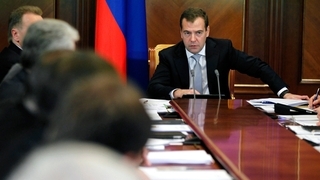
A meeting on road traffic safety
Dmitry Medvedev’s opening remarks:
Our country's doctors send their greetings. I have just attended their first national conference, and can tell you that they are concerned about the issue that we have met to discuss today, which is road traffic safety. Unfortunately, as with many other events, discussions of this issue are not held regularly, but only when a tragedy occurs, that provokes public anger. Decisions are taken and then our attention to the issue slackens once again. I recall that we addressed this issue as a package two years ago. I don’t mean that the decisions we took then were wrong – no, they were absolutely correct decisions, but judging by recent developments they were not sufficient. Unfortunately, about 30,000 people die in road traffic accidents each year, which is a horrible statistic. I don’t know if traffic accident statistics are equally horrible in any other country, possibly with the exception of countries where there are open hostilities. So our decision to discuss this issue again (and not only because of the tragedies in Moscow and other places that shook the country over the past two weeks) is evidence that road traffic is far from safe in Russia.
In 2006 we adopted a targeted federal Road Safety Programme and started implementing it, and it has registered positive results. The number of road traffic accidents diminished consistently by approximately 7% a year. But unfortunately, although the number of traffic accidents continued to decline over the past 18 months, the number of traffic-related deaths, including deaths of pedestrians, has increased. The most widespread reason for this is not traffic conditions, organisation of traffic or complaints about our road services or traffic police, but drink driving. This is something you cannot blame on the Government or government bodies; it is a problem of the people.
The number of traffic accidents involving those whose driving licences had been revoked in the past has increased by 50%. This is something to consider. Over the past year, the number of drivers who have refused to undergo medical check-ups after an accident has increased by 30%. We know what this means -- that they refused because they were intoxicated. I’d like to remind you that in some countries, which we consider to be relatively free of trouble in this area, for example Spain, such behaviour is classified as refusal to comply with a police officer’s request, which is punishable by a fine of about 2,000 euros in Spain and up to 10,000 euros in Italy. But in Russia, people easily drive when drunk, drive way over the speed limit into the oncoming traffic lane, and drive through red lights... Completely out of control! They throw empty bottles out of car windows and shoot into the air or at people.
This is a major problem. After the recent events, the traffic police held a seven-day inspection in Moscow and established that 1,300 drivers were drunk. This is crazy! Eleven of them were caught drink driving for a second time, and one of the drivers was caught drunk for the 20th time. Why hasn’t his licence been revoked? What are we waiting for, more victims? The situation was unique in some cases, for example, a driver who has been deprived of his licence 33 times by a court decision, yet he continues to drive. This reminds me of a quotation from a classical book: “It’s amazing how you can be so happy and still be a free man!” This is a glaring example of the impunity that exists, and the absence of restraining factors.
Now a few words about the legal aspect of this issue: I suggest that we focus on this, because although we will also discuss other issues, such as the moral aspect and encouragement [for good driving], the legal aspect is still the main issue of concern for both the executive and legislative authorities. The fines for this offence are really trifling, between 100 and 5,000 roubles. I am sure that those who drive drunk are prepared to pay 5,000 roubles. Frankly speaking, many have this sum in their pockets. Like in the joke: they drive up, open the window, give the traffic officer the banknote, and drive away. In this case, a traffic accident can be defined as a result of criminal negligence. People driving under the influence probably do not plan to injure anyone, they don’t plan murder, but they definitely have a criminal intent – to drive while drunk; this is certainly premeditation. This raises the issue of punishment. I am not going to make the decision now, because a set of measures has been submitted for discussion to the State Duma and the Government. What I suggest is that we consider making intoxication an aggravating circumstance for both administrative and criminal offences. In other words, drivers should know that intoxication will be considered an aggravation in the event of an accident.
Many proposals have been made, from very harsh to quite moderate punishment. I suggest that we consider the issue calmly and determine which proposal we will support in a consolidated manner. One way or another, we should change our approach to responsibility - not maximise punishment or increase fines, but change our approach to responsibility for such offences, because there has never been such laxity before. People knew that there was a limit beyond which they must not go. This did not happen even in the 1990s, when the situation was much worse, people’s incomes were much smaller and there were fewer cars around (today nearly every family has a car).
Currently, there are about 50 million cars in this country. If we multiply this figure by three, it works out that the average family has a car, and many families have two or even three cars. The Government is providing comprehensive support to the national automobile business. Global auto concerns are establishing production in Russia, we issue consumer loans [for the acquisition of cars]; in fact, we have issued so many such loans that it’s probably time we stopped to think about their influence on the lending sector. On the other hand, all of this could be quite good, as according to modern standards, each family needs a car. But we also know how driving lessons are organised. We all know how shoddily they were organised in the past, but now they have become a mere formality, with driving licences bought or, at the least, the future driver’s skills not properly assessed. Driving schools do not have properly equipped driving ranges or modern simulators. There are no schools to train driving instructors whatsoever. There is a need to develop training programmes for driving school instructors. The Ministry of Education and Science should set about doing so and the Ministry of Transport should develop regulations governing child safety and additional regulations covering passengers and cargo.
We have good programmes for reducing traffic accident injuries. They are really good and things look pretty good here. In any case, we have an emergency roadside assistance programme, aka the golden hour programme, in place and it’s even getting better. The number of ambulances available is growing, and traffic is also improving, albeit slowly. The response is provided faster so, in this sense, things look more or less good, although, of course, the situation needs to be monitored.
In August, the Government introduced a bill to amend the law On Road Safety. I think that further amendments will be needed and they will be drafted based on the results of work currently being carried out by the State Duma and today's meeting. In particular, mandatory health checks for drivers should be conducted at least every five years. This is probably the right thing to do to get the situation under control at least in general terms.
I won’t even speak about the family, school and education, so as not to add to the rhetoric. However, everything that’s happening now shows that things look extremely bad in this area. Schools should offer some easy-to-memorise programmes so that children understand what can and cannot be done. Such things can be taught in spite of all the problems associated with modern life. This has to be done all the more so since the number of vehicles is increasing and the legal driving age is getting increasingly lower.
In many countries, people start driving at a fairly young age. There are countries where people start driving at 14, but these countries don’t have such problems. Of course, accidents happen, but things that are happening in Russia are unimaginable anywhere in the world. Children start driving way earlier now than you or I did in our time, that’s a fact. Most of us sitting at this table didn’t own vehicles when we were 18, and our families didn’t own them, either, at least that was the case in my family. There were no chances for us to drive. An occasional taxicab ride was as close as we could get to a vehicle. But there’s no way to go back to this kind of life. Any student can make enough money to buy some kind of a clunker from what they earn at a summer job. He will buy it and drive it. Almost all school graduates go to colleges now, so you’ve got them all behind the wheel now. The question is what kind of drivers they are. Are they going to follow the rules or are they going to drive the way we saw?
Well, that’s the emotional side of the situation that I shared with you. Now, let's set emotions aside. I would ask Viktor Kiryanov to inform us briefly about the current situation. No extensive reports please, because we meet regularly and discuss things, most of which I have already covered. Then, we’ll have other colleagues add their comments. Let me be straightforward about it: the way I see today’s meeting is to formulate balanced proposals with regard to amending the law. These changes don’t need to be drastic, but they should be tough.
<...>
