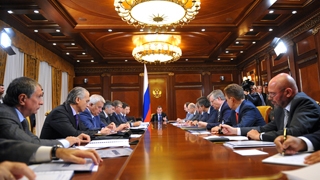
Meeting on stimulating hydrocarbon production
Dmitry Medvedev’s opening remarks:
The issue of improving taxation in the oil and gas industry has been among the priorities of the Government and, of course, of analysts. I held a meeting on this subject in June and also issued a number of other relevant instructions within the framework of the presidential commission.
As you know, the tax and customs payments of the fuel and energy industry constitute the lion’s share of deductions to the federal budget, and are clearly a vital component of our development. But in addition to this fiscal element, we must also ensure the progressive development of the industry – that is, we must plan its development for an extended period and make the industry more attractive to Russian and foreign investors. In other words, the Government must not only collect money from the industry, including from state companies – even though we have to do this from time to time – it must also bolster its development, and then there will be more money to collect.
But to be able to do this, we must look ahead and attract additional resources for the development of new fields, which will create jobs both in the fuel and energy industry and in related industries. Such projects usually need major investment, modern technologies and a relevant regime of regulation that would ensure the payback of investment, increase efficiency and create economically substantiated profitability standards. What are we suggesting? I will outline several positions, as this is what we have come here for.
First, we must introduce a standard transparent mechanism for stimulating the development of new hydrocarbon deposits. I am referring to the procedure for calculating export customs duties on crude oil and a number of products made from it. This will allow extending the planning horizon for investors, and will also make the Government’s policy in the oil and gas sector more predictable, which is vital. By the way, this is what all of our colleagues say, including the heads of state and private companies and foreign investors. They say that the predictability of the Russian market is even more important than the terms of operation themselves. In this sense, far from everything is as it should be, and we must do our best to reduce the range of changes, or better still, to rule out any change of terms for the foreseeable future.
Second, we must extend our previous decisions on mineral production tax rebates for oilfields located in several regions, in particular the Republic of Sakha, the Irkutsk Region and the Krasnoyarsk Territory. I am talking about the period until 2022. Eastern Siberia and the Russian Far East obviously need new growth points, as well as investment and skilled professionals.
And third, we must differentiate the mineral production tax rates for the gas industry. I’d like to remind you that the Government has recently discussed the issue of increasing the financial burden [on the gas industry], including by approving a new procedure for calculating the mineral tax for it, but only with due regard for the situation in the industry and for current trends on the gas market. It has been estimated that this would increase deductions to the federal budget by a certain sum, which may not be very large but it will still be considerable – around 17 billion roubles. On the other hand, it is obvious that we will also need to apply a stimulating approach to the development of new natural gas fields.
I also issued instructions to consider the possibility of introducing a formula for calculating the mineral tax rate for natural gas from 2014. The idea is to differentiate tax rates depending on the mining, geological and geographic factors.
We can also speak about what has been done and discuss new proposals, if any. This is the agenda for today. Let’s start working.
<…>
