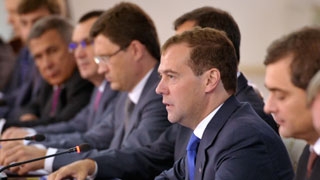
A meeting on innovation development of agriculture and energy industries
Transcript of the meeting:
Dmitry Medvedev: Good afternoon! Please have a seat. Once again, good afternoon everyone. According to the text of my speech, we have done a lot for the development of the foundations of an innovation economy. I can’t say how much we have done, but it is true that we all have been working on this, and this is not a figure of speech. The priorities have changed, we have adopted a strategy of innovation development until 2020, we have created the main links of this system, which of course include development institutes, and the legislation that we have made more or less acceptable in the past three or four years. The attitude toward university science and support for young specialists has changed. I will not quote figures; I expect that my colleagues will say something in this respect. We have adopted strategies for innovation development of large companies with part-state ownership and strategies for creating a demand for inventions. This subject was very difficult, many people were not exactly eager to work on this, but we used our administrative resources and found willing and eager people. We have held a competition for choosing territorial clusters to uncover and support innovative growth centres in regions. We have selected 25 such clusters. They are diverse. For refining, for example, there is the Kama territorial production cluster in Tatarstan; in the sphere of coal and industrial waste products – the Kemerovo Region, in the sphere of biotechnology – the Moscow Region, and so on. There are many examples. New tools, such as technology platforms, have been initiated. These platforms help coordinate the research and development efforts of business and the scientific and educational communities in the preproduction stages, as well as establish the most commercially promising areas for research. We have approved a total of 30 such platforms; we will see which of these will prove to be viable. All the aforementioned things are the results of our joint work with you – I mean both the innovators, the scientists, business representatives, and the government officials. This work will go on - I will continue with this work. I consider it to be the main area of the government's activity, I have repeatedly said this - I said it on the very day when the new government was formed. To date the new government has resolved its organisational issues and is ready to continue its work on creating the foundations of an innovation economy. I want you, all those present here, to hear about it. This work will be conducted, as it has been conducted, within the framework of the Presidential Council. In the past I created the Presidential Commission, however the President issued a decree to rename it, and now it is called the Presidential Council. The Council will also have its presidium headed by the prime minister, so the form of this work is the same but for some nuances.
We have set an ambitious goal of increasing the proportion of high technology and science intensive economic sectors in the national GDP by 30% by 2018 as compared with the level of 2011. This is a major challenge.
To achieve this indicator, we should work closely on analysing and stimulating innovation policy on the non-financial sector. I’d like to add that all five priorities named earlier, our five strategic priorities of innovative development, will remain. That is energy efficiency and energy conservation including the creation of new types of fuel. We saw in Rostov-on-Don today such miraculous new types of fuel, for example, made of sunflower seeds – a fuel that does is not very usual for us but it has a presence both on the international market and in Russia. It is especially popular abroad, where they value such things. Our priorities also include nuclear technology, space technology (primarily in the area of telecommunications and navigation systems), biomedical and information technology. All this remains on the table, as we say in such cases.
Today we will discuss the achievements and challenges in the innovation development of our leading sectors: agriculture and the fuel and energy sector. There is a persistent misconception, and often we perpetuate it ourselves, that the agro-industrial complex and the fuel and energy sector, that is, the raw materials sectors have almost no demand for innovations because these sectors continue to do essentially the same thing that they did 500 years ago. Of course, this is an absolute misconception. It is precisely these sectors that create the demand and are the drivers of this demand throughout the world, and they are part of economic modernisation.
As far as agricultural production is concerned, naturally, the agricultural producers should participate in introducing state-of-the-art science-intensive domestic research and development both on the federal and the regional levels. So far we have adopted the Strategy for Innovation Development until 2020. It will be implemented through a state programme, which we approved in mid-July. This programme stipulates federal allocations of almost 24 billion roubles for technical and technological modernisation. However, it is equally important that other dedicated agencies actively join the efforts in terms of technological platforms. There are various areas where the existing capabilities can be applied: for example, the GLONASS system that we mention so often can be used to monitor crop yield, agricultural operations and the volume of transportation. I’ve just seen the equipment fitted for this. So far there are not too many people who can accept these changes even mentally, but this is very important and indeed creates opportunities for using high precision farming technology, which is highly efficient and very profitable.
It is equally important to share international experience, to work with foreign research institutions, invite foreign experts to our institutes and universities, as well as to other organisations, and to publicise scientific achievements. When we were in the courtyard a short while ago, we spoke to a colleague. We mentioned the issue of patenting Russian research and design. The issue of patents is not so simple but all of us realise that we cannot protect our interests without patents. Someone here asked a question about patenting Russian designs abroad. This involves a lot of work and requires organisational resources, in-depth legal knowledge and money. There was a proposal to establish a single centre so that small- and medium-sized businesses could use its services and protect their designs under Russian and foreign patent laws. I believe that we can have such a centre created at Skolkovo. I think that this is the right place for doing this kind of work.
Now with regard to the fuel and energy sector. Since 2011, nine major state-owned companies in the energy sector have adopted innovation-driven development programmes. We have reviewed them many times, because we have on many occasions debated the difference between innovations and the kind of regular technical modernisation that everyone is involved in. Anyway, over the last year alone we allocated almost 200 billion roubles for the implementation of such programmes and, most importantly, (this is a really impressive figure) 50 billion roubles for scientific research alone. This is really important. The five largest privately owned oil companies have spent nearly $0.5 billion on R&D (research, development, design and technological work). That may not be a huge amount, but it's a good starting point.
We need to realise, however, that additional and more effective incentives still need to be developed, and the focus should be on ensuring environmental safety and the development of energy efficiency projects. Everyone is aware of what is at stake. The issue is one of increasing recovery rates of oil and gas wells and making more effective and complete use of the appropriate fields. It is also about processing the associated gas into synthetic oil and other liquid fuels, and, of course, about alleviating the environmental impact. It's about technology for building smart grids to control the modes of operation of energy systems, as well as about protecting power lines against well-known problems, such as corrosion and icing, which will significantly reduce transmission losses. These are all Russian designs. For example, 160 participants, including software companies, have been registered with Skolkovo’s Energy-Efficient Technologies cluster alone. Of these, 34 have been approved and have been issued grants amounting to 1.8 billion roubles. A significant proportion of these grants have been already released and distributed.
The state programme for energy conservation and energy efficiency, which is designed to reduce GDP-related power consumption by 40% by 2020, is already in place. This is an ambitious goal, but I hope that we will stay the course and achieve it. Subsidies upward of 5 billion roubles are being allocated on an annual basis; the government has issued guarantees covering 10 billion roubles with regard to similar projects in industry and the housing and utilities sector. Funds for research and development are being allocated as well. Of course, Russian energy companies should be encouraged to participate in the technology platforms, such as deep processing of hydrocarbons, hydrocarbon production and utilisation techniques and Russia’s Smart Energy System. Generally speaking, all these projects are underway. We are not beginning this work, but rather carrying it on. I believe that this is the right time for us, during the uneventful month of August when all of Europe is on holiday, to sit down and talk about this, so that we do not waste our time. I hope I didn’t ruin your holiday plans and if I did please don’t get frustrated because we will soon be done.
Let's start a dialogue on this topic. First, I would like to have the Energy Minister speak. Please, go ahead Mr Novak.
Alexander Novak (Energy Minister): Thank you. Mr Medvedev, colleagues, the fuel and energy complex is the driving force of the Russian economy, and we are well aware of the level of our responsibility as Russia transitions to an innovation-driven path of development. Russia’s fuel and energy sector has huge potential for using innovations, since it’s a major industry in need of modernisation that will require tens of trillions of roubles. Sales by the fuel and energy complex amount to about 20 trillion roubles annually and its investment programmes already stand at 2.6 trillion rouble per year. As you mentioned, Mr Medvedev, investments may serve as drivers for creating and implementing innovations in the fuel and energy sector and related industries. Investments are also important if we want to substitute Russian-made products for items that are currently being imported. The volume of investment in the energy sector is estimated to reach 30 trillion roubles within the next ten years. International experience shows us that effective public administration in the energy sector can help create innovative industries, such as renewable energy sources, shale gas production, smart power grids and electric-powered vehicles, within a very short period. Each of these areas is a powerful catalyst for innovation-driven economic development. The business volume of these industries runs into hundreds of billions of dollars, which offers huge opportunities for the creation of new jobs, economic diversification and establishing new points of growth.
The nature and structure of the mineral resource base is a major factor behind this demand. For example, we are entering a phase where traditional oil and gas fields will soon be exhausted and significant amounts of oil and gas will have to be produced in regions with harsh climatic conditions and low levels of infrastructure development. The need to improve the energy efficiency of fuel and energy enterprises and the economy as a whole is also among the key factors driving the demand for innovation. The current energy consumption in Russia is two to three times higher than that in the leading industrialised countries, and our goal is to reduce this figure by 40%.
Another important factor behind the demand for innovative technologies is the impact of the energy sector on the environment. The solution to environmental problems depends on the large-scale introduction of modern power plants, full utilisation of associated petroleum gas, increased efficiency of boilers and coal-fired power plants, as well as on greater use of nuclear power plants and sources of renewable energy in overall energy supplies. In order for us not to fall behind the rest of the world technically, we need to focus on conducting scientific research, designing and implementing these technologies and integrating Russia's scientific potential with global scientific research efforts.
Mr Medvedev, as we were getting ready for today’s meeting, we ran into a problem: how do you quantify corporate spending on innovation? Actually, the only spending item that now can be pinpointed is how much a company spends on research and development activities. Of course, a company's level of competitiveness, its market share and productivity are important factors that determine the innovative nature of a company in general.
This slide shows our current position in terms of innovation. It also shows how much state-owned companies spend on research in relation to their revenues. Notably, these expenditures are on a par with the best international companies and often even higher. This trend has been in place for the last three years. At the same time, we realise that the quality of innovative activities by Russian companies needs to be substantially improved and investments should have a greater rate of return. For example, you can see that while Exxon Mobil has a lower innovation-related spending to revenue ratio, it registers hundreds of innovation-related international patents a year in areas such as exploration, production and refining. That’s more than all the Russian oil and gas companies combined. The situation is similar in the electricity supply sector. Russian companies outperform their foreign-based counterparts in the R&D spending to revenue ratio, but they register 5 to 10 times fewer patents. Therefore, one of our proposals for today’s meeting is to have an instruction issued with regard to conducting an analysis of the effectiveness of the implementation of programmes for innovation-driven development in 2011 and 2012 and putting together proposals for the revision of key performance indicators, meaning that these should be not just figures showing the percentages of revenue spent on R&D activities, but also indicators showing the quality and effectiveness of the innovative solutions being implemented.
Next, I would like to identify the essential technical provisions, which, according to the Ministry of Energy, will determine the future of the oil industry for the next 10 to 15 years. First, the shale gas revolution that has taken place in the global oil and gas industry owes its origins to the multiple hydraulic fracturing technology. The technology itself is nothing new, but its secret lies in finding the right combination of this and other processes to stimulate the reservoir and maximise oil recovery. The right combination is identified through building complex geological and geophysical models, continuous experimentation and fine-tuning of solutions. So far, no innovative solutions have been identified for Western Siberia, and the oil recovery factor remains extremely low at about 37%, while in the developed countries it stands at 65%-70%. The effective use of these technologies will help unlock stranded oil and gas reserves; therefore, we are focussing mainly on the multiple hydraulic fracturing technology in combination with other recovery stimulating techniques.
The second area of interest is related to oil and gas production off the Russian shelf, primarily in the Russian Arctic regions. These reserves will remain untapped without significant technological breakthroughs in creating autonomous subglacial and underwater field development systems using modern robotic systems.
The third important area includes a set of technologies associated with the liquefaction of natural gas, primarily using GTL technology, and the liquefaction of coal bed methane. Large GTL plants have been built around the world for a long time now, but this is not an innovative solution for exporting liquefied gas. Instead, the technology based on mini-GTL plants seems to be quite promising, since it makes it possible to build relatively small gas liquefaction plants. A breakthrough in this area would fundamentally change the structure and competitiveness of the Russian oil and gas industry.
This next slide shows promising technologies in the coal mining industry that are currently being researched, developed and implemented. Of these, I would point out, first, shaftless technologies and the development of coal deposits based on gasification, hydrolysis and biotechnologies. The introduction of these technologies will eliminate the need to have people working below the earth's surface and significantly improve safety. The second important area has to do with deep processing of coal, that is the production of synthetic liquid fuels and other products of coal chemistry. We believe that the introduction of this process will jumpstart the manufacture of innovative products and open up new markets.
The next slide shows innovative technologies in the electricity generating industry. The one that I would like to draw your attention to are the developments in the area of high-temperature superconductivity. The Federal Grid Company and the Federal Agency for Atomic Energy (Rosatom) are currently involved in this work. The use of these technologies will cut energy losses in the equipment by 80% and will significantly increase grid capacities.
The establishment of domestic coal-fired power generation plants based on supercritical steam parameters will significantly improve the efficiency of power plants by up to 44%-50%. It should be noted that the above areas of research and development conducted by fuel and energy companies are totally in line with global trends. Of course, the success of these developments and turning them into commercially viable operations will boost the competitiveness of the entire economy in the future.
I would also like to point out that the innovative activities of oil and gas companies have improved over the past three years. The companies are using the latest tools in their innovative activities which the prime minister mentioned in his opening remarks. This includes independent innovation-driven work to create their own R&D centres and the creation of joint enterprises with their suppliers, equipment, and partners. This “technology for markets” formula has already started working.
I would like to note just a few examples: the setup of the Arctic Offshore Projects Research Centre, a joint venture of Exxon Mobil and Rosneft for the transfer of advanced offshore technology with a budget of $500 million for the coming years. Another example is a joint venture between RusHydro and France’s Alstom to manufacture hydropower equipment for small and medium hydropower stations on the territory of the Russian Federation: the investments have already totalled about 120 million euros. Also, the Federal Grid Company of Unified Energy System Russia, Silovye Mashiny and Toshiba have launched a joint venture manufacturing power transformers; the plant will be commissioned in 2013.
Second, we see and take note of innovation activities in the fuel and energy complex implemented with government support. It has already been mentioned that following the instructions of the Presidential Commission for Modernisation and Technological Development, nine companies designed and approved innovation development programmes. Apart from that, interaction with research institutions has been established: the Russian Academy of Sciences, university research centres, development institutes such as Skolkovo, Rusnano and Vnesheconombank. Territorial clusters have also been set up. The state programme for energy conservation and enhanced energy efficiency has been launched and is gaining momentum. In 2009 a decision was made to design a sub-programme for the development of electric power equipment and power engineering for the period of 2012-16. At present the programme is being drafted by the Ministry of Industry and Trade. The deadline has been moved to 2013. The sub-programme is meant to facilitate the development of key innovation technologies such as combined cycle gas units, coal block elements with super overcritical parameters, and coal cycle gasification. Mr Medvedev, taking into account the importance of this programme for companies’ innovation development, I would like to ask you to issue instructions for this draft sub-programme to be approved in the shortest possible time. The Ministry of Economic Development supports it, and this could push for new breakthrough technologies with government support.
Despite significant progress in the establishment of innovation development institutions and jumpstarting the innovation process, unfortunately, the rate of introducing innovations in practically all the branches of the fuel and energy sector is fairly low. As innovation activity in certain sectors grows, new problems become salient and require a solution. The positive side of the coin is that those problems are associated with growth. From our point of view (after communicating with companies), growth problems can be divided into two categories. First, there is a set of issues related to the fact that, on the one hand, innovation services suppliers often underestimate long-term demand for their services from fuel and energy companies. On the other hand, the buyers, who are the source of innovation demand, are not ready to work with new technologies and suppliers that have not been test-run by their companies. This creates a vicious circle that we have to break. The Russian Energy Ministry conducted an analysis of the world’s best experience, which shows that such problems in other countries are basically resolved and there are positive examples of this kind. I personally like Norway’s experience, where there is a sector-wide system of procurement with key consumers and suppliers of the oil and gas sector registered and working within the system which has its own clear-cut standards of supplier classification and which ultimately allows for competing companies’ operation due to a transparent and understandable procurement system, including for the high-tech market. This kind of mechanism stimulates the emergence of new businesses and makes access to high-tech services for operating companies considerably easier and in the end ensures the competitiveness of the oil and gas industry.
By the way, although Norway only started offshore oil field development in the 1970s, it can boast today that local companies export modern innovative technologies and services for the world’s oil and gas sector in the amount of over $20 billion a year.
To put it figuratively, it is an electronic exchange of ideas, technologies and projects reinforced by specific long-term orders.
The second important element that should be borrowed from the world experience is the need to realise new instruments and new forms of selecting and commercialising the technologies, which is not a widely accepted approach among Russian fuel companies. The example of other countries demonstrates that such an instrument as corporate venture funds run by professional investment managers makes it possible to greatly increase competition for an idea or capital inside a corporation.
The Norwegian Statoil’s foundation Energy Capital Management is yet another good example. It currently runs assets of over $250 million, and actually reviews and constantly sifts through new ideas, compares them with the existing technologies used by the company. Relying on that experience and on our assessment of innovation activity, the Energy Ministry has submitted seven proposals aimed at the development of innovation in the fuel and energy sector. I have already named some of them in my report, and I would like to spell out the others. There is a proposal to issue an instruction to set up a nationwide system of suppliers with qualification requirements and a transparent competitive system of application; a proposal on legislative changes to ensure long-term investment programmes for the period of no less than five to seven years for fuel companies with state participation to promote innovative products and services; a proposal to submit suggestions on increasing innovation openness of energy companies with state participation to secure the possibility for independent research centres and innovation companies to conduct expert evaluation and test-run new technological solutions. Thank you. My report is complete.
Dmitry Medvedev: Thank you very much. There’s only one thing – to always stick to the protocol. This must be hereditary: Igor Sechin used to make long reports, and now you do the same. You should try to keep it brief.
Now regarding this issue: let us discuss the situation with research and development. I looked at the table comparing R&D of Russian and foreign companies which Mr Novak showed us earlier. Indeed, Exxon Mobil has 329 patents but the share of the revenues from sales is 0.22% whereas our Federal Grid Company has 35 patents but its share of revenues is 1.38%, which is a good figure. That’s why I give the floor to Oleg Budargin. Please, brief us on what has been done.
Oleg Budargin (chairman of the board, Federal Grid Company of Unified Energy System): Thank you very much. Esteemed colleagues, Mr Medvedev, the innovation development strategy of the nation’s grid complex stipulates the creation of smart grids of the new generation. We started designing the programme of new generation high voltage class grids in 2010 and now we have reached a qualitatively new level of the programme: comprehensive introduction of innovations from smart power to smart consumer. The programmes approved by the board of directors of FGC and MRSK provide us with the major research guidelines. They outline seven areas of work with the main power grids and four areas with the distribution grids. A research council was set up jointly with the Russian Academy of Sciences for independent evaluation, for coordinating independent assessment: four of the twenty council members are members of the Russian Academy of Sciences. This allowed us to thoroughly go review those areas and to identify the starting points to be set in order to attract as many interested parties as possible both from Russia and abroad. We have identified those directions. They include first of all new types of power equipment, control systems and many more. The main point is that research and development for our company is conducted not only by the sector’s specialised institutes, which is 60%, but also by small and medium-sized businesses (12%), and universities that so far only account for 5% but there is a good potential and promising programmes. Within those directions a monitoring of technologies was conducted in the world and in our country, and applications were submitted for addressing the problem points in those areas.
Slide No. 3 shows the links in the innovation process: articulating a problem, search for ideas, collection and analysis of proposals, R&D proper, pilot projects and commercialisation. We have done a lot of work with the Academy of Sciences, and the academic community has discussed various opinions and approaches to those areas. In 2011 we received 481 proposals related to them. We selected 140 projects and divided them into breakthrough technologies and upgrade technologies. Today 20 of those 140 technologies are run in a pilot mode, and two technologies are already being replicated.
The fourth and fifth slides show the success of our pilot projects at various design stages. But what matters most is that our ideas and R&D have won confidence beyond Russia’s borders. Foreign companies also take an active part in our work.
Our priority projects include a digital substation, an alternative current superconductive high-temperature cable in Moscow, and a direct current line in St Petersburg. We have started building an electric car service infrastructure. We are also implementing the Count, Save and Pay project for distribution grids in Perm. With pooled efforts of the Federal Grid Company and the Interregional Distribution Grid Company, we provide the synergetic effect of united innovation activities, as you see on the sixth slide.
The innovation drive helps the Federal Grid Company to promote its intellectual achievements in the market. This technology is truly innovative and highly competitive. Last year, the company obtained 36 patents, two of them international, and made four license contracts with three agencies. More than ten technologies are getting on a commercial footing.
Together with its Russian and foreign partners, the company is developing the manufacture of state-of-the-art electric equipment in Russia for Russian and foreign innovations. We are opening a plant in Vladivostok in a few days to manufacture cutting-edge electric equipment in partnership with Hyundai. Another joint venture, with Siemens, opened in Voronezh this summer. It produces pioneer transformers for hydrotechnical equipment. We are particularly proud of our Tatkabel plant. We have launched the production of 6-330 kW cables – the 6th voltage class – without any aid or long-term contracts, and are now testing a500 kW cable.
Regrettably, there are no testing centres in Russia for the entire electrical equipment production cycle. Their absence impedes the implementation of innovation programmes, electrical equipment export, and the development of smart electric grids.
The Soviet Union had five major testing centres, and Europe has twenty while Russia has none. Decisions were made to establish such centres but the Federal Grid Company is stricken off investment programmes time and time again. Not that this country cannot afford the funding – there is only a lack of goodwill. We hope the new Ministry of Energy will provide us with some support, and the company’s investment programme at last will include a project designed together with the Russian Academy of Sciences for a modern testing centre.
We have organised multi-sided partnership with universities on the innovation development programme – from participation in research and development (they are responsible for 5% of it, as I have said) to our participation in tuition. We regard personnel training as an essential tool for the implementation of innovative ideas.
Mr Medvedev, I planned to make three requests but now I want to make just one, the most important one. Please instruct the Federal Grid Company and the Energy Ministry to include the establishment of a major testing centre in Russia because it is the basis and the most effective tool of implementing the company’s investment programme.
Also please allow Professor Andrei Rudskoi, the rector of the St Petersburg State Polytechnic University, to make you a gift after this meeting. It will be a new collection of articles and a set of textbooks in token of our lasting partnership in personnel training for innovative projects.
Dmitry Medvedev: Please do.
Oleg Budargin: Thank you.
Dmitry Medvedev: Thank you very much.
I did not comment on the minister’s speech in this respect but I will certainly analyse all the seven proposals made there, and we will issue relevant instructions. As for the sub-programmes, including the one you mentioned (it is all about the development of electric equipment and energy-efficient engineering, if I understand correctly), let us also determine what to do.
The situation with the testing centres is lamentable. As you said, the Soviet Union had five such centres and Europe presently has twenty while there are none in Russia. I am not sure about project costs. It will require 10 to 12 billion [roubles], as is written here – not an exorbitant sum. I am ready to issue instructions concerning your investment programme but I think we must analyse the situation as a whole because we need such centres not only for the energy industry but also for engineering and other industries. Naturally, we will implement the idea as a public private partnership. Let us discuss the way it should be done. We should try to bring our positions together because it is in the interest of this entire gathering and a vast number of businesses not represented here.
All right, that’s settled. Let us move on to the BioTech 2030 platform. We will hear some reports on that and then we will hold a discussion. I’ll give the floor to everyone who wants to make a brief comment.
Vladimir Popov, the director of the Bach Biochemistry Institute, will speak about the technical platform. In brief if possible, please.
Vladimir Popov: Thank you. Mr Medvedev, ladies and gentlemen,
Biotechnology is a key element in the innovation development of the economy today alongside IT and nanotechnology. The global biotechnology market will reach $2 trillion by 2025 and by 2030 up to 35% of chemicals, 50% of farm products and 80% of medicines will be manufactured with the use of biotechnology. It will account for 2.7% of the developed economies’ GDP, and its share will be even greater in the developing countries. Next slide please.
Regrettably, Russia lost the Soviet Union’s leading positions in biotechnology in the 1990s. The Soviet Union was self-sufficient in microbiological albumen, amino acids and other products essential for the agro-industrial complex. True, all sectors of the biotechnology market have been steadily growing for several years now but, as you see, this market entirely depends on imports. The measures taken on the national leadership’s initiative some years ago aim to address these problems.
Next slide please. All developed economies in the world, particularly the United States, the European Union, China and Brazil, have adopted long-term strategies for the development of biotechnology. Russia possesses the lion’s share of the world’s forests, the most fertile of the world’s arable land and a vast stock of fresh water. All this is a formidable basis for a future biotechnology oriented economy or at least some of its sectors.
Russia has a vast territory with a sparsely populated eastern part. This makes biotechnology oriented economy a critical social factor: it promotes the relocation of economically active people to the remote parts of the country and rural areas, creates new jobs and guarantees reliable local energy supply basing on regional resources. The BIO 2020 programme, adopted in April for the comprehensive development of biotechnology, is the first high-level document determining the state policy in its respect. The programme was drawn up with the active participation of three technology programmes – our Bioindustry and Bioresources, Bioenergy, and Medicine of the Future.
Next slide please. The Bioindustry and Bioresources platform represents public private partnership and so can have an impact on diverse economic sectors, primarily farming, the timber and food industries, as well as the chemical industry, waste processing, mining, ore and mineral processing, and aquaculture.
Next slide please. Our platform unites more than 150 organisations. These are the country’s leading universities, research centres engaged in natural sciences, major industrial enterprises and science-and-production amalgamations, trade and professional unions and associations, and smaller biotech companies. The platform has good working relationships with all the development institutions and federal executive bodies, which use it mainly as an expert group for reviewing biotech projects.
I’d like to briefly mention several successful instances of major biotech innovation projects that should hopefully have a significant impact on the relevant economic sectors and in whose implementation members of our platform are involved. One of them is based on the RT-Biotechprom biotech combine in Eastern Siberia. This branch of the Rostekhnologii state corporation is building an experimental installation for high-tech products made of cellulose fibre. That’s timber processing waste – sawdust, in other words. This is this country’s first plant manufacturing butyl alcohol, organic acids and other chemicals out of renewable biomass instead of hydrocarbons and it is based on Russian research. The plant will open in 2014, and the equipment is being installed now. The cost of the pilot project is estimated at 800 million roubles, one third of which was provided by the Ministry of Education and Science. If this innovation technological cluster proves successful, other hydrolysis plants will emulate its experience. In this way we will shift to a cutting-edge, clean and highly efficient technology away from timber acidolysis, which is hazardous and seriously pollutes the environment.
Another ambitious project, in the Belgorod Region, focuses on all-round processing of low-price poultry materials, like feathers, down, and sludge and bone residue from poultry meat processing. It is based on Russian R&D, which is streets ahead of the rest of the world. The project has come through all stages of implementing innovations: initially funded privately, it eventually received a 180 million rouble grant from the Ministry of Education and Science. At present, Rosnano is implementing a 4.5 billion rouble joint venture with a consortium of foreign investors. Two plants, currently under construction, will manufacture hydrolised proteins that are the basic ingredient of many foods and fodders, and have considerable export potential. Design work is currently underway in Italy and France.
Other inspiring examples include the Omsk Technological Cluster, which integrates agricultural, chemical and biotechnological production. There is also a project to build a plant [in the Belgorod Region] to produce 35,000 tonnes of lysine per year, an extremely valuable feed additive. Sibbiopharm Co from Berdsk is the industry leader and a successful global exporter.
Russian researchers have much to offer Russian businessmen. Next slide please. Here you can see just a few examples of technology and products manufactured in experimental batches or ready for mass production. We can offer farmers biological fertilisers, pesticides and feed additives; we can offer vets vaccines and test kits. There are also systems and sensors for monitoring the safety of raw food stuffs and ready foods, and biodegradable packaging.
In the fuel and energy sector we can offer microbiological technology to increase oil recovery, chemicals for drill fluids, and the knowhow for cleaning oil-contaminated soil and oil spills.
Next slide please. The extensive use of biotechnology has significant economic effects. A characteristic of biotechnology is that it has high indirect economic benefits – for instance, a reduction in environmental pollution as a result of clean biological components replacing toxic chemicals, and improved quality of the end product.
I can cite as an example the use of enzyme feed additives. Even small amounts of them improve the health of livestock. Animals are fattened more quickly and have better quality meat, and expenditures on medicines are reduced. This table shows the intended effects on certain farm products with the implementation of the Bio-2020 Programme. If fully implemented, there should be a $30 billion overall profit by 2020.
In conclusion, I would like to say a few words about what is standing in the way of the extensive use of biotechnology in Russia. Next slide please.
We realise that innovations cannot exist in a vacuum. They must be in demand – that is, they need businesses to implement them in order to gain a competitive advantage in particular markets. It is regrettable that the markets for biotechnology and its products are still in their infancy, with negligible volumes of trade. That is why businesses have shown little interest in them and are turning their back on innovations.
If we are to put into practice all the benefits of biotechnology, we first of all need sales markets for biotechnological products. For that, we need the entire arsenal of government tools – technical regulation; stricter environmental standards; and a consistent state purchasing policy to encourage demand for biotechnological products, be it biodegradable packaging or oxygenated additives to engine fuels.
Now it sometimes comes to absurdities. The current law outlines subsidies for the purchase of chemical fertilisers and pesticides, but this law does not apply to their biological analogues, even though they are much friendlier to the environment. We need a thorough and profound revision of the legislation to promote the manufacture of biotechnological products, and the elaboration and implementation of system-wide measures to protect their Russian manufacturers – Russian, I emphasise.
I fully agree with the previous speaker. Biotechnological production requires large-scale factories, which take a long time and considerable resources to build and involve technical risks. Even an excellent laboratory prototype cannot turn into production technology overnight – it has to go through all the stages of pilot testing. Breakthroughs demand new and unprecedented testing blocks and pilot systems, the construction of which costs several hundred million roubles, which Russian developers cannot do without government funding. They will be doomed without such complexes, which can be described as biotechnological product prototyping centres, while Russian businesses will go on purchasing complete technological solutions abroad.
All these measure and activities are detailed in the Bio-2020 Programme. It’s a good, sound programme, which accurately reflects the main vectors and trends in biotechnology today. However, this programme is today nothing more than a letter of intent: a programme of coordination without any funding.
To fully exploit the potential of the Bio-2020 Programme and promote the development of biotechnology in Russia, we need to bring its measures down to the departmental programmes of the federal executive agencies and, even more importantly, to the programmes of the major companies with state participation, backed by relevant financing. Last but not least, innovations are never introduced in this country unless by compulsion. That is why it is essential to establish a permanent high level consultative body to monitor the implementation of the programme.
In conclusion, I would like to say on behalf of all the forum participants…
Dmitry Medvedev: To whom should this body be subordinate if it involves compulsion? The Security Council? Or the Defence Ministry? Which do you think is the best option?
Vladimir Popov: It must be an agency at a sufficiently high level to move everybody along.
Dmitry Medvedev: Okay, we’ll think about it.
Vladimir Popov: It might be subordinate to the Commission for High Technology or its presidium.
Dmitry Medvedev: I see. Thank you very much. As for the testing facilities, I think we should make some progress on the matter if Mr Popov, Mr Budargin and other colleagues say it’s necessary. I’ll order Mr Surkov as the deputy prime minister in charge of modernisation in the government to convene a meeting. We have to find the money for it. You were right to say that businesses must be compelled to introduce innovations, but it’s a general point while the compulsory establishment of testing centres is a natural and practical consequence of it. We will have to pool together private and state funding. That’s the only way to do it.
We will have to talk to companies because we are making sizeable allocations for research and development, and companies are also funding it – good on them. However, when it comes to testing centres, the impression is that everyone expects a windfall with the government signing an executive order allocating billions of roubles to establish a dozen centres. That’s not the way to do things! What we need to do is convene a meeting to make decisions on specific practical issues. Let’s say, it costs $200 or 300 million to build and equip a centre, so we will make a collection and fund it for the whole country to use the centre. Let’s do it like that. But then, there are progressive companies who have a lot of patents.
We are now on the premises of Yug Rusi Company, so it would be a shame not to give the floor to Mr Sergei Kislov, President of the Yug Rusi Group. Please go ahead, Mr Kislov.
Sergei Kislov (President of the Yug Rusi Group and Chairman of the Agro-Industrial Union of Russia): Thank you very much, Mr Medvedev.
Ladies and gentlemen, allow me to thank you for convening this meeting. We find its theme extremely topical because Yug Rusi is engaged both in the agriculture and energy sectors. Slide No. 4 please.
We find it particularly symbolic that this meeting has been convened on the eve of our company’s 20th anniversary. All these years, we have been actively engaged in innovation. We have an implementation centre of our own. We work both independently and in cooperation with scientists – including the All-Russia Research Institute of Fats in St. Petersburg or the Don Regional Research Institute of Agriculture at the Russian Academy of Agricultural Sciences as well as many others.
Slide No. 6 please. I cannot list out all our innovations in this brief speech, so I will only mention some of them.
Dmitry Medvedev: Mr Kislov, just how many patents does your company have?
Sergei Kislov: More than 60, in all fields. We have even patented non-alcoholic vodka. It might find its customer someday.
Dmitry Medvedev: You will treat us to it someday, and we’ll sing melancholy songs – just the kind of tunes for such a drink. How many foreign patents do you have?
Sergei Kislov: The 60 patents concern only our own R&D.
Dmitry Medvedev: Have you patented anything abroad?
Sergei Kislov: Yes, we have patented our products in the European countries we sell them to. We have to do this to prevent counterfeiting, protect our products, etc.
Dmitry Medvedev: I see. Go on please.
Sergei Kislov: For instance, we have introduced the innovative method of putting liquid nitrogen into the packaging, which protects the oil from oxidation and considerably improves its quality during storage.
Slide No.8, please. Another sample of the work of the Yug Rusi centre of new technologies is the innovative method of enzymic hydration of vegetable oil, using physical rather than chemical purification of the oil, which is important for healthy nutrition.
Slide No.12, please. Creating a proper information environment is of particular importance for the development of the agriculture sector. Together with Agropromsoyuz, we have launched Russia’s first agrarian television channel Agro-TV. Mr Medvedev, you mentioned the need to establish such a television channel at the All-Russian agricultural congress in Barnaul a while back. This new TV channel is also available online on the Agro2b website, which was launched this year. Agro2b is a unique resource, which comprises both business and trade without intermediaries, and is also the country’s first agrarian social network. Another one of its functions is to allow the exchange of experience in successful innovations in the agriculture industry, while the website’s trade system gives young people the opportunity to launch their own business, and with the use of crowdsourcing as well.
Slide No.15. Another important issue is bioenergy.
Dmitry Medvedev: How does it use crowdsourcing?
Sergei Kislov: For instance, a student or a pensioner can visit the site and see what is being sold and purchased there, and then combine two companies and earn money that way, e-money. Very interesting.
Dmitry Medvedev: I don’t think that’s exactly crowdsourcing.
Sergei Kislov: But it does involve ideas and innovations…
Dmitry Medvedev: It’s a very useful thing, no doubt.
Sergei Kislov: We make public any idea or innovation available, including complex ones, and announce the cost. Various individuals or groups engage to put forward their proposals or start working with them.
Dmitry Medvedev: I see.
Sergei Kislov: Now, speaking of bioenergy. For the first time ever in Russia, we have introduced the innovative method of producing fuel pellets from agricultural waste materials, which you have seen today. Husk fuel is in demand in Russia, and is being actively exported to Europe and the price of it is going up. It should be mentioned that four years ago we launched this project and emerged on the market, selling…
Dmitry Medvedev: Back then, did anyone take your husk fuel seriously?
Sergei Kislov: You know, we have always initiated things that no one else does. Four years ago, we sold the first batch of vessel cargo for $1 per ton – now it sells for over $100 per ton. Today this is a stable market, and we were the ones who created this market and we are developing it.
Dmitry Medvedev: That’s great!
Sergei Kislov: You know, Russia actually has an abundance of biomass, and if we continue to develop this market it will become a substantial market niche. It should be noted that I am talking about the use of non-food agricultural raw materials. Slide No.16 shows the importance of non-food agricultural raw materials for manufacturing “green” diesel fuel. This a completely new type, not biodiesel but “green” diesel, one that is mixed with mineral diesel, with a cetane number of about 100. This is the most innovative type of biofuel in the world today. Yug Rusi is in charge of producing it at the Novoshakhtinsk Oil Products Plant, while the Omsk Institute of Hydrocarbons Processing is developing the original technology for using Russian raw materials. This is expanding the sales market for agricultural producers, which is particularly important under WTO membership.
Mr Medvedev, we need to make use of the successful experience of Europe, especially in terms of working in the WTO, to protect the profitability of farming. This is a request. Currently the subsidies in Russia are 2,000 roubles per hectare, while in Europe they amount to over 260 euros, that’s 10,000 roubles, per hectare. As part of the WTO, we are competing on the international market, say, in Africa or Egypt, and it is really difficult for us to compete there with our wheat as local manufacturers are simply pushing us out of the market.
Dmitry Medvedev: Will a smaller subsidy solve the issue?
Sergei Kislov: No, this will only decrease competition. We could do this, but it will affect competition, especially since…
Dmitry Medvedev: We were planning a payment of 500 roubles per hectare, if memory serves me. Am I right, Mr Fyodorov?
Nikolai Fyodorov (Minister of Agriculture): Yes, you are.
Dmitry Medvedev: And this definitely meant we had to exert ourselves. By 2020, subsidies per hectare are set to almost double. Is that correct? That will be good.
Nikolai Fyodorov: Yes.
Sergei Kislov: But today we are saying that there will be no other subsidies, neither for fertilisers nor for pest control. Just as in Europe: a per hectare subsidy which you can use any way you want. This offers considerable freedom to farmers, which is a good thing about the market. Yet we would like the subsidy to be at least comparable to the European level, if not the same as in Europe. This is important. We are asking you to issue an instruction to consider subsidising profitability. I’d like to say a few words about holding companies: we still expect to have a law on them, because it is the leading and other holding companies that implement innovation, because they have the necessary resources. This is why we are waiting for a law on holding companies…
Dmitry Medvedev: What exactly do you mean? In principle, we have legislation on holding structures. What do you have in mind?
Sergei Kislov: Transfer prices and pricing systems…
Dmitry Medvedev: The pricing procedure?
Sergei Kislov: Yes, so that we can have a clear system of operation and so that tax agencies and market players can have a clear view of our work. Thank you very much.
Dmitry Medvedev: Thank you. Colleagues, you have heard the main reports, so to speak. Please feel free to express your opinions. Of course, I don’t expect you to make an analysis of the situation, but rather to put forward suggestions on the actions we could take, because I did not have a full list of instructions when I invited you, but some have come to mind while I listened to the reports. Please, what else do we need to do in the two areas which we are discussing today? Who wants to go first?
Igor Pavlov: I am Pavlov, Vice President of Rosneft. It has been said here today that issues of innovative development [should be formulated] for regular customers and for business for five years ahead… I would like to suggest we consider the possibility of developing the catalyst business in oil refining. As of now, the development of Russian catalysts is limited to laboratories, nothing further. We are buying Axens and UOP catalysts, which are entirely foreign technologies. But we need these catalysts in the same way you need toothpaste: all companies from the oil refining sector need them every year, so there will be a stable demand for decades to come.
The next area is motor oil additives. The quality of Russian products is very low here. Not a single service station – with the exception of AvtoVAZ – offers Russian-made oils, which is a sad state of affairs. It all depends on having a good basic framework, technology and good additives. This too is a long-term project, for decades to come. This is our proposal from Russian business. I’d like to say on behalf of Rosneft that we plan to invest 9.2 billion roubles in R&D in 2012, which is 0.6% of our revenues. We have also registered the Centre for Innovative Research (CIR), which we will register as a Skolkovo resident; we are receiving government assistance for this project. There are modern technologies and pilot facilities for developing catalysts there, but only at the laboratory stage unfortunately. That concludes my report. Thank you.
Dmitry Medvedev: Thank you. Tell me about the catalysts and oil additives you mentioned: are you involved in this process at all?
Igor Pavlov: Yes, of course. Our Centre for Innovative R&D has developed catalysts for hydro-treating, hydro-cracking and isodewaxing in laboratories, but at the next stage we need these testing centres for pilot-commercial development. We are missing the middle link, because in world practice laboratory tests are followed by pilot work and industrial operation only comes after that.
Dmitry Medvedev: I see. I have a proposal. I understand that you also need testing centres. Let's have all parties take part in these efforts, including Rosneft. I think this would be the right thing to do. It will be easier for you to take part in this once and to use the results than to invest in something on a case-by-case basis.
Okay. Go ahead, please.
Sergei Brindyuk (general director of the research-and-production company Belagrospetsmash): We are having a bad harvest this year. I’d like to ask you what has been done in Russia in agriculture to minimise the risks from bad weather through the use of agro-bio technology. Russia has every opportunity to avoid a draught because we have a lot of winter water. This is a resource many countries don’t have and we could use agro-bio technology to preserve the capillary structure of soil, because losses from bad weather are running into the billions of dollars today.
Dmitry Medvedev: Colleagues, please don’t ask me questions. Have you come to interview me or what? Formulate your proposals, please. What do you suggest?
Sergei Brindyuk: I propose using the accumulating functions of soil without upsetting its biological structure. It is necessary to use equipment that would not damage the structure of soil, thereby allowing it to accumulate the necessary water. In the case of protracted rain, it is possible to use equipment on low-pressure tyres, for one, in order to minimise…
Dmitry Medvedev: If I’m correct, you are now simply advertising the equipment that you’ve just shown me, right? I guess, it perfectly fits the purpose you mentioned. What a smart approach – first, what has been done and then what needs to be done…
Sergei Brindyuk: You’ve asked me about this.
Dmitry Medvedev: I see. Have you discussed this with Mr Chubais (Anatoly Chubais, chairman of the Rosnano Board) or not? Mr Chubais, there is a need for your products. Please, speak with your colleagues, okay? Thank you.
Vasily Golubev (governor of the Rostov Region): May I?
Dmitry Medvedev: Please.
Vasily Golubev: Mr Medvedev, I’ll just make a few proposals. It was mentioned today that by 2030 bio technology will have been used in the production of half of all agricultural produce. Researchers in the Rostov Region are actively joining the work on priority directions of the Bio Tech-2030 Platform. We’ve created an impressive research potential – nine higher educational institutions, eight research institutes, two selection stations and many enterprises that are translating R&D into practice.
I’d like to make the following proposal, which we have thoroughly considered. We believe we are fully justified to host a powerful centre for the innovative development of the agro-industrial sector. We think it will help Russian agricultural producers to become more competitive and will enhance the quality of their produce. No doubt, it will also be useful in the context of our accession to the WTO. So, I’d like to ask you to support our opinion. In turn, considering that we have a law on the public-private partnership (it was adopted in 2010 and went into effect in 2011) we could fund all engineering work and road construction. This is very good for business because they reduce the cost of developing and implementing new projects by a quarter.
Second, experts believe that to achieve the maximum effect from the Bio-Tech Platform-2030, we must develop our agro-industrial complex in clusters. We have experience in this area. Using the afore-mentioned law, several enterprises in our region are working in different areas. For example, Amilka has achieved unique level of corn refinement by using nanofiltration. The food and chemical industries require the use of such methods on a broad scale.
We are now processing about 300 tonnes and will process 450 tonnes by the end of this year. Our company BioTech is starting the construction of another complex on deep grain refinement with a German partner. This country needs this cluster and we are actively working on it. This is yet another cluster that we are forming, having assumed obligations on engineering, road construction and a number of other directions.
I think that cluster development requires our common attention and in this context I’d also like to ask you to consider co-financing such projects, along with the regions.
We have a serious problem in a shortage of processing production lines, including those that use bio technology. This is very important for us, because we are losing added value, producing semi-finished products, sending them abroad and, of course, are letting this money slip away. This is why this is a very urgent issue. Thank you.
Dmitry Medvedev: Thank you very much, Mr Golubev. Go ahead, please.
Remark: Mr Medvedev, in our agency we are now completing work on a roadmap for access of small and medium business to the purchase of companies with state participation as part of the national business initiative. We believe it is small and medium businesses that must form the innovative field for big companies, including those involved in fuel and energy. Therefore, I fully support the proposals made by Mr Novak. I’d like to subject this road map to discussion so that we can listen to big corporations as well as medium and small companies that are interested in offering their innovations to big business. Thank you.
Dmitry Medvedev: Sure. Needless to say, I have no objections because this is absolutely the right thing to do. Allow me to give the ministers the last word. Go ahead, please.
Viktor Filatov (deputy general director of the Agro-Belogorye Group of Companies and general director of AltEnergo): Good afternoon, Mr Medvedev. I represent the Belgorod Region. My name is Viktor Filatov, director of the Institute of Alternative Energy and the company AltEnergo, which is implementing the projects we have been talking so much about today. I don’t know whether you remember or not, but in July 2010 you held a meeting of the State Council in Alekseyevka in the Belgorod Region. You gave us a number of instructions and our governor asked us to report on their implementation. I’d like to emphasise that the implementation of these pilot projects may produce a new industry, an entirely new direction in our power engineering and agriculture. As for the reports made today…To be honest, it's a shame that we are so far behind Ukraine and the rest of Europe. We must catch up with them.
Today the Belgorod Region has learned to produce poultry and pork on a very large scale (show the second slide, please) and thus, aside from production (show the next slide, please) we now have a certain amount of waste. This is our raw materials base for forming the areas that are so much in demand now. Several speakers have said that we are particularly active in developing four directions of the platform-2020. These include nanocellulose (we’ll show what projects we’ve carried out), functional proteins, keratins and lysins, but I’d like to dwell on alternative energy. Show these slides, please – these are the projects that we’ve implemented in our region. You will remember Alekseyevka, the plant that was put into operation last April and is now working. There are no world standards for proteins and keratins…Food and other supplements, lysins… And our main project that we have been working on for the last two years – we’ve built Russia’s biggest solar power station with a capacity of 100 kW (on the one hand, we can be proud of it but on the other, it’s a shame). We’ve also built five 20 kW wind turbines. This is small-scale generation, but this experience shows us that we must build solar stations and wind turbines in Russia wherever possible.
That said, I think that the most interesting, breakthrough project is a biogas unit. We have 1,300 agro-industrial facilities in the Belgorod Region. I’m referring to stock breeding and processing. This biogas unit disposes of the waste from just two of these facilities – 75,000 tonnes. We produce 20 million kWh of electricity per year, sparing our region about 15 million tonnes of carbon dioxide emissions from this station alone. We also produce 65 thousand tonnes of organic fertiliser. It is necessary to replace mineral fertiliser with organic and to stop using the former in agriculture.
What did we do next? Please show us the remaining slides! All these projects could hardly be implemented without the scientific community, without support from ministries, departments and business entities. We attracted funding; Sberbank supported us and extended a loan for the project, although the process was difficult, many issues were unsolved. Next slide, please. We did everything that had to be done in the Belgorod Region: laws were adopted, a council for biotechnologies presided by the Governor was formed, and to date, we have developed a programme for implementation.
The 12th slide. This is the placement territory – these distributed [power] generation [sources] cover the whole territory. We analysed the situation: currently the Belgorod Region has over 10 million tonnes of livestock farming waste, of processing enterprises, solid waste, waste disposal plants and so on. If we process all this waste to produce biogenic gas, then we can produce some 230 megawatts of power. The Belgorod Region has a shortage of power, the region produces only 5% of power and purchases the rest, therefore we will be able to meet the power demand up to around 75% of the Belgorod Region population, and we'll be able to build over 100-150 biogas units placed within the region, which will make it possible to reduce the synergic effect, to halve the losses in distribution networks. I mean that the power generation sources will be located in those places that have consumers.
We get a lot of fertiliser, over seven million tonnes, and I want to support my colleague who said it is necessary to subsidise these fertilisers today rather than to subsidise applying these fertilisers. We have a concept as to how these projects can be implemented today. We have some experience and we have a team that is ready, in terms of the Belgorod Region (next slide), in terms of the innovative territorial biological cluster that has been created, to implement projects on waste treatment in full, on producing power and heat that can be used for heat supply to housing, social facilities and in building heating systems for greenhouses. There are some problems that it is necessary to resolve to this end. I’m sure that by 2015 we will be able to produce in the Belgorod Region at least 10% of power created on the basis of renewable energy. There are issues such as the approval of the so called green tariff by the Federal Tariff Service of Russia (FTS), and a decision as who will be taking this power from us. Unfortunately, today we have problems with the contract model. This introduces changes to regulatory acts, because it is necessary to use organic fertilisers and to support these projects in the same way as agro-industrial projects, that is, by subsidising the interest rate, through partial co-funding, and credit resources (our credit leveraging is between five and seven years, and if it was between 10 and 15 years, these projects would be competitive with the current prices in the market energy sector). Thank you.
Dmitry Medvedev: Thank you very much. This was interesting. Indeed, this production is interesting. Mr Minnikhanov (to Rustam Minnikhanov), go ahead please.
Rustam Minnikhanov (President of the Republic of Tatarstan, Council Chairman of the Association of Innovative Regions of Russia): Mr Medvedev, meeting participants! I would like to inform you about the results of the work of the Association of Innovative Regions of Russia, since I happen to be the Council Chairman of this association. Mr Bortnik, the executive director, is here as well. The association was formed on May 21, 2010. It unites 12 regions – the Irkutsk, Kaluga, Lipetsk, Novosibirsk, Samara, Tomsk, Ulyanovsk regions, the Republic of Tatarstan, the Republic of Bashkortostan, the Republic of Mordovia, and the Krasonoyarsk and Perm territories. Eight committees oversee the work and interregional interaction with the association: each region is represented, and system-wide work is being conducted. The number of regions, participants of the association, that are engaged in the economy accounts for 19%. They produce 32% of total high technology production and 92% of nanotechnology production in Russia. The tasks of the association include stimulation and sharing experience on creating favourable legal, economic, social and creative environment, on developing innovations, as well as organising and promoting joint projects among the participants of the association and development institutes of Russia: these include Rosnano, Skolkovo, the Strategic Initiatives Agency, the Russian Venture Company, Vnesheconombank (VEB) and so on. The current total VEB investment in large projects in the association’s regions is 193 billion roubles, and VEB investment in small and medium-sized enterprises in the association’s regions amounted to over 724 billion roubles. We have achieved a high level of cooperation with the Rosnano corporation, which has pledged to fund 15 projects; of these, it has already funded ten projects.
The level of activity to promote innovative projects for the Skolkovo high-tech centre is growing. More than 70 projects proposed by the association’s members have been already approved by Skolkovo. Tatarstan was given the “15 projects” status.
The association is a platform for implementing major initiatives aimed at innovation-based development of the national economy. It is also actively interacting with federal and regional government bodies and legislatures.
Following your instructions, the Economic Development Ministry completed the competitive selection of territorial innovation clusters in May 2012. Eight of the selected clusters are in regions that are the association’s members. The Economic Development Ministry has proposed attracting our experts to monitor a programme for the development of these clusters. They have a high potential for innovation-based development, but there can be no innovation without investment. It is essential to support the regions that implement innovations with grants, and to further intensify interregional and inter-cluster cooperation, to share experience and technology with other regions. We are currently working on a proposal on various forms of state support for projects implemented by territorial innovation clusters, for example, through including these projects into targeted federal programmes and government programmes. Federal executive bodies must work out a common position on these issues.
How to assess the innovation-based development of regions and clusters, and individual facilities, is also an issue. We studied the experience of the European Union and the United States and tried to adapt their approaches to the Russian specifics. As a result, we have developed a system of assessing the level of a region’s development in terms of innovation. The concept of this system has been approved by the Economic Development Ministry and can be used while considering the advisability of providing financial support for the regions with the best developed innovative economies.
Another important question, Mr Medvedev, is how to assess the effectiveness of technology parks, which are an integral part of regional innovation systems. The association is currently working on evaluation criteria. Once a system is drafted, it needs to receive interregional expert approval. The association has long been cooperating with influential international organisations on the improvement of assessment tools in the sphere of innovation. For example, Tatarstan is developing pilot programmes for the development of the intellectual property market.
We also encourage our experts to engage in lawmaking activity. The association members are part of a working group in the State Duma that considers bills on a federal contract system. Our experts also sit on a working group to analyse legislation in the research and innovation sphere and propose the necessary legislative initiatives.
The association is also ready to have pilot bills tested on its territory. I would like to thank you, Mr Medvedev, on behalf of the participating regions, for your support of the association’s initiatives. Thank you.
Dmitry Medvedev: Thank you. Mr Minnikhanov, what about the building of a test facility in Tatarstan?
Rustam Minnikhanov: Pardon me?
Dmitry Medvedev: Concerning the building of one of the experimental facilities in Tatarstan?
Rustam Minnikhanov: We are already discussing that, we have an agreement.
Dmitry Medvedev: Your region is the most advanced, I'm serious. Let’s do something special!
Rustam Minnikhanov: We will submit our proposals soon, because we have already discussed this project conceptually. We have discussed it, also because we have already built a cable plant…
Dmitry Medvedev: That’s what I was talking about.
Rustam Minnikhanov: …and we are actively participating in the work on the automation system.
Dmitry Medvedev: All right. Please colleagues, I think we can hear from three more people, and then I will give the floor to the Agriculture Minister, and we will begin summarising this meeting. Go ahead please.
Igor Kozhukhovsky (General Director of the Energy Forecasting Agency, co-chairman of the Technology Platform "Small Distributed Power"): My name is Igor Kozhukhovsky, coordinator of the Small Distributed Power Technology Platform.
Mr Medvedev, ladies and gentlemen,
I am grateful to Viktor Filatov, who raised the issue of small distributed power in the Belgorod Region. This is actually one of the fastest growing segments of the energy industry in developed economies. Unfortunately, we are dependent upon Western technologies here. For example, imported equipment accounts for 75% of our gas powered electrical generators, and for 100% of our microturbines, because they are not produced in Russia.
Saturn Gas Turbines, which makes low and medium capacity gas turbines, is our main producer of power generation equipment. Last year, Saturn initiated a project to build standard power generating units of up to 50 MW for the heating systems in towns and municipal districts. The project was supported by the Industry and Trade Ministry and by the Technology Platform. The ministry provided 500 million roubles for 2012-2014, and Saturn invested another 500 million, for a total of one billion roubles to finance this programme. Of that amount, 100 million will be spent on building a test facility. This is an example of a project which is already underway – I mean an example of a public-private partnership that involves a test facility, something we discussed here.
I would also like to say a few words about one important system-wide problem. I head the Energy Forecasting Agency, which is responsible for drafting the general plan of location of energy facilities until 2030, and a government energy efficiency programme. A major problem we are facing is the discrepancy between the government planning horizon and that of investment planning by energy companies. Government programmes are planned until 2030, while energy companies rarely plan anything beyond the next five to seven years, except for two or three large state controlled companies such as Rosatom, RusHydro, and the Federal Grid Company. This limitation prevents energy companies from acting as customers for innovative energy equipment developed by Energomash. This calls for certain measures to harmonise the government and corporate planning horizons. Thank you.
Dmitry Medvedev: Thank you. Please, take the floor.
Alexander Kvochkin (Rector of the Michurinsk State Agrarian University): Thank you, Mr Medvedev. I am the rector of the Michurinsk State Agrarian University, but today I am representing the technology platform, “The Processing Sector of Agribusiness: Healthy Eating.” This is a topical issue, especially for industrialised countries. We believe that our platform is similar to two European programmes: Plants for the Future and Food for Life.
Why Michurinsk? I believe there is a solid reason – the third slide, please. So why Michurinsk? We have been working on the issue of healthy foods since 2004 when the development programme for Michurinsk Academic Town was adopted. We are working in every stage of the technological chain, from cultivating new plants with an enhanced biological value (both for consumption and as raw material) to finished product.
Just a few examples. The fourth slide, please: Pumpkin products. It is a very simple plant, commonly presented at school fairs and major agricultural exhibitions. What is its unique feature? It’s anacidity. Our stomach simply loves pumpkin dishes. We have patented our varieties. The unique part is that they have a higher content of dry matter and sugar; they are sweeter than melons. We can use soft technology to produce functional pumpkin-based foods without any sweeteners.
The next, seemingly simple plant is the tomato. We have cultivated tomato varieties with enhanced lycopene content of up to 8.3 mg/%. The content of lycopene in ordinary varieties is 1.5 mg or 2 mg at the most. Lycopene is a cancer fighting agent, which promises new achievements in this sphere. We have also recently cultivated a tomato variety with a sweet protein, thaumatin, which is the main raw material for diabetic foods. Thaumatin is currently produced in the amount of 50 tonnes from raw materials grown in a small area of Central Africa. Our variety has an almost unlimited raw material capacity. Another unique but seemingly simple product is blackcurrants whose antioxidant capacity is three times larger than that of lemons. Its universal feature is the high pectin content. Pectin for the human organism is like washing a room. We have created a series of new varieties, including a black chokeberry. Serbs have created a whole family of products based on black chokeberry, which has been included in the European catalogue of healthy food. We have cultivated a rowan tree with sweet berries, which you can eat uncooked. Rowan berries are unique for their ability to stabilise blood pressure, that is, lower high pressure and raise low pressure. There are no artificial drugs with this unique property, and so you must watch carefully which medicine you take, because a mistake could be deadly in this case.
Mr Medvedev, I don’t represent the end products, but I’d like to remind you that we showed them to you at an exhibition in Michurinsk last August – the five series of products which have been tested and recommended by the Research Institute of Nutrition of the Russian Academy of Medical Sciences.
Interest in business projects has been growing. A major Green Valley project underway in the Tambov Region was launched for production of new plant varieties. It has an area of 2,000 hectares and there are plans to increase it to 40,000 hectares. They will start a large processing business next year. Currently we have a small plant with a capacity of 5,000 tonnes a year. It rolls out pilot batches of these new plants. But there is considerable interest in mass production and we hope to be able to produce these healthy plants in large amounts in time for the Sochi Olympics.
As for problems, our biggest problems are equipment and personnel, in particular paying salaries that would attract people to this sector. In terms of equipment, we take part in competitions, and quite successfully, and we are also developing small innovative businesses. We have created a laboratory block as part of our innovation infrastructure. Fifteen of our small innovation companies receive assistance from the so-called Bortnik Fund. Mr Medvedev, we take part in competitions, but, unfortunately, one of our problems… The food sector is currently not a most favoured participant in the majority of competitions. For example, a competition for assistance to regional clusters ended a few months ago. We took part in it, but as you know, in the biomedicine sector. We don’t feel bad though, because it is better to buy and eat healthy food and so remain in good health, than to deal with health problems. However, we would like [these competitions] to have an agrarian category too.
Another problem concerns small innovative companies, which cannot operate without land in the agrarian sector. But although we have land at our disposal, we cannot provide it to small innovative companies. Paradoxically, one of our own innovative company works on a land plot provided by our neighbours and another company teamed up with a local farmer. I believe that Federal Law No. 217 should be amended to allow us to transfer the land, land which we received for unlimited use, to small innovative companies. Also, Government Resolution No. 505 should be reviewed too, because the procedure for attracting external investors is too complex. To be able to create a modern research unit and regularly invest in it, we should establish these companies within the framework of public-private partnerships, but we are hindered by limitations on the provision of land plots for such facilities. The scheme of Resolution No. 505 is too complicated. Thank you.
Dmitry Medvedev: Thank you, we’ll think about it. Let’s analyse the issue of the agribusiness category. Actually, there are no, nor can there be any objections to establishing an individual agribusiness category [at competitions].
As for the provision of land to small innovative companies, frankly speaking, it depends on the intentions of the parties involved. I don’t doubt for a second that such a procedure is necessary for the Michurinsk State Agrarian University, but I personally worked hard to resolve the issue of land plots of the Russian agricultural academies. I can tell you that I saw chaos, unprofessionalism and self-interest. So we should weigh the matter carefully before taking a decision. I cannot take an independent decision for a good, innovative university. Well, we’ll think about it.
Alexander Kvochkin: You’re right, Mr Medvedev, there are risks involved. Thank you.
Dmitry Medvedev: Next, please.
Nikita Ageyev (Director General of Novas Energy Services): Thank you, Mr Medvedev. I am Director General of Novas Energy Services, a tenant business at Skolkovo. The company is one of the few who have received a Skolkovo Foundation grant. We create and implement plasma impulse excitation technology for enhancing the recovery of hydrocarbons. The technology is based on the principles of nonlinear physics, a science where Russia still keeps a leading position. At present, we are implementing three programmes based on this technology. One of them is being implemented within the Skolkovo framework and is aimed at ensuring full use of the potential of horizontal oil and shale wells. This programme is developing very efficiently thanks to assistance from the Skolkovo Foundation. Both foreign companies and various investment firms are showing interest in it.
The second programme, which we are implementing jointly with Gazprom Geofizika, involves methane wells at coal deposits. We launched that programme six months ago and have already held the first successful field trials. We and Gazprom Geofizika are now planning to offer this programme to Gazprom, which could use it for the production of commercial volumes of methane from coal deposits.
And the last programme, which we are implementing independently, provides for increasing oil recovery from vertical wells. It is currently used by several Russian companies, such as Tomskneft, Polar Lights and Kogalymneftegaz. We hope to overcome the psychological barriers and demonstrate the advantages of this technology to as many companies as possible. I’d like to make a proposal on behalf of the majority or all small companies. It would be good if large corporations, when implementing their innovation programmes, could pay a little more attention to the designs and developments of small companies, thereby making it possible for these companies to run pilot projects or experimental work in order to demonstrate the effectiveness of their developments. For example, our company holds six Russian patents and one US patent, and this experimental work is currently being conducted with great difficulty in Russia. However it is being conducted, I could name the companies. On the other hand, western companies have more stable interest. But our priority market is the Russian domestic market. Thank you.
Dmitry Medvedev: Thank you very much. I recall that we visited your company a short while ago. I suggest that you give it to me later, because we have spent a lot of time in the Kemerovo Region. Thank you for your hospitality. I am glad to see you among the innovators, and not only among those who work with traditional power generation technology. Mr Fyodorov (to Nikolai Fyodorov), go ahead please.
Nikolai Fyodorov: Mr Medvedev, colleagues. The prime minister has announced that the state programme for agricultural development will include subprogrammes for technical and technological modernisation and innovation development worth over 20 billion roubles until 2020. The lion’s share, some 7.5 billion roubles, is spent on technical modernisation, essentially on innovations and biotechnology. Is a lot or a little? To be honest, it's difficult to answer; moreover, it's difficult to ask for more funds. Why? In particular, for example, because between 2010 and 2012 (this is a known example) the Russian Academy of Agricultural Sciences (RAAS) received 20.5 billion roubles in federal budget funds, and in addition the academy has 1.5 million hectares of land – the best land, land of special value, some unique land, the prime minister has mentioned this. Meanwhile, everybody, including some agrarian universities that do not possess this kind of land, have doubts about the degree to which this land is being used efficiently by RAAS. Therefore, RAAS proposals should meet the demand of the real sector in the economy, taking into account the scientific, technical, land and property potential of such proposals. In fact, the practical payback of Russian research is extremely low in this area, Mr Medvedev. There is no demand for the absolute majority of design and development. For example, according to a RAAS report, in three years, RAAS institutes created (with 20 billion roubles, as I mentioned) four types and 35 new selection forms of animals, birds, fishes and insects, 883 species and hybrids of farm crops, 915 new and improved technologies and so on. Simultaneously, during this same period, Russian agricultural producers imported foreign technologies worth billions and billions of roubles, and we exported Russian developments for 27 billion roubles. Our agricultural producers tell me: “Why do we need these developments? Give us at least one development like the Angus cattle that the Americans have developed, and with which they now control half the globe.” This is an example of where and how people work and how efficient they are.
In this context, to be brief, perhaps it would be prudent, Mr Medvedev, if you could widen our mandate (let me be precise) for coordinating the work of this state institute according to the demand of our agricultural producers. I will not ask you to recall that following its accession to the WTO, Ukraine decided to include the National Agrarian Academy in the system of the Ministry of Agriculture of Ukraine and to appoint the its president as the first deputy minister of agriculture. I do not wish to directly follow the example of our Ukrainian brothers, but there is something to think about.
Dmitry Medvedev: Thank you. You are right, there is something to think about indeed. To be honest, I have been thinking about it for some years, including under even more radical scenarios. However let us think about coordination, about relevant academies and the state funds. The Russian state approves constituent documents and all other things relevant to the academy, and the government approves something too. Submit your proposals and we will think about how to contribute at least to more efficient research in this academy and in some other academies.
I’m not eager to conclude our discussion because I see that our colleagues have more to say. If you have something very important to say that would form the basis for a necessary instruction, I am ready to listen for another five or seven minutes, but not to presentations of achievements. You know that we have exchanged remarks with Mr Surkov. These meetings have become more substantial than they were three years ago when we began this work. Why? Because we have seen results. Perhaps these results are not fantastic, but everyone present here is telling us what has been done, including with the use of state mechanisms, state institutes and with state support (in addition to one’s own interest and one’s own private initiative). This means that gradually, and with difficulty, our institutes are gaining momentum and are yielding results. In fact, I’m pleased about this.
However I asked a question: are there any instructions, ideas for instructions? Please, go ahead.
Nikolai Fyodorov: Mr Medvedev, I am also representing a Skolkovo resident and, as noted in Mr Novak’s report, today, introducing innovations is certainly hindered by the fact that companies have no incentives. Development institutions have been created, and they help us implement innovative projects and solutions. But perhaps it would be possible to adopt a decision that would stimulate companies rather than forcing them to introduce these solutions? And once they have been introduced, other companies could then adopt them either through market mechanisms or by compulsion. Thank you.
Dmitry Medvedev: We need to think about it. At the moment, I don’t have a clear understanding of how this is going to work. But we can certainly think about such mechanisms that can be used for the two-phased approach. Are there any other proposals for government agencies and ministries? Does the Finance Ministry have any comments?
Andrei Ivanov (Deputy Finance Minister): We are busy writing down all the proposals.
Dmitry Medvedev: That’s your job.
Andrei Ivanov: I would just like to emphasise the fact that it is not that innovations are impossible without money, but rather, that innovations are impossible without investment. And there is a lot that needs to be done toward this end. We have already reported to you on the efforts to revise our investment legislation and on the state programme to develop an innovative economy and investment. This programme would offer the government new ways to participate in innovation activities and to direct the available investment toward pilot ideas, projects, and areas.
For that we... Naturally, we won’t be asking for a separate assignment, since we have already been working on this, but this is our basic position on the issue. Also, our colleagues should realise that the public-private partnership does not mean an increase in public funding, but rather an efficient use of public funds within the stated priorities. And based on this ideology we are ready to implement all assignments.
Dmitry Medvedev: As always, a touch of optimism from the Finance Ministry, but that’s what they are supposed to do. Anybody else? Go ahead, please.
Vadim Vaneyev (General Director, Eurodon agricultural complex): Mr Medvedev, Eurodon is a turkey producer. We have developed a project from scratch. We took the first step by importing commercial eggs from Canada and England. We then developed the second project on genetics, which was the first step. The assignment to Mr Fyodorov – he raised the issue that people are asking for a specific breed of cattle. We acted in unison: two weeks later the owner of the company (there are just two companies in the world that control turkey) came to us, he had never visited Eurodon before.
Dmitry Medvedev: Where are these companies from?
Vadim Vaneyev: From England, but the owners are Germans. The German owner is very much in control. He was very surprised that we had implemented this project. And just about a month ago we asked them to develop for Russia with the help of their geneticists (six people will be coming)… In Russia, they eat more dark meat than breast. Here, let me show you (showing a photo), it’s 45 kg. This breed was developed by them. Could you pass it along, take a look please.
Dmitry Medvedev: What’s this? It looks frightful from a distance.
Vadim Vaneyev: Mr Medvedev, as I've always said, I can’t even come up with an example of how to convince people that this is not some kind of genetically modified ... There are shepherd dogs and there are mutts, and this is a shepherd that has been bred. It took them 40 years and tens of millions of dollars to breed it. Tens of millions! Our breeds weigh 20 kg, and this one is 45 kg.
Dmitry Medvedev: How much does it weigh?
Vadim Vaneyev: 45 kg.
Dmitry Medvedev: A turkey weighing 45 kg!
Vadim Vaneyev: That was the whole point, we wanted to beat the Americans – their turkeys are 39 kg, and we’ll have 45 kg ones.
Dmitry Medvedev: Thank you. This is very interesting. Did you say this was an English breed?
Vadim Vaneyev: Yes, English. But we are working with two companies, English and…
Dmitry Medvedev: Can we get anything like that from our scientists? Anything at all?
Vadim Vaneyev: They are coming soon and I will try convincing them to develop it jointly here in Russia, the thigh and dark meat breed. Dark meat is very popular in Russia. Breast is…
Dmitry Medvedev: I see.
Vadim Vaneyev: And that is why they will be developing it for us. We’ll be making investments and working in this direction.
In addition, in six months we are completing the Peking duck project. The turkey project is being financed by Vnesheconombank.
Dmitry Medvedev: You have whetted our appetites, and everybody seems to be very interested in the topic.
Vadim Vaneyev: But the genetic centre on the basis of… We’ll need two: the ducks are not available in Russia, this will be the largest project in Russia – 20,000 tonnes.
Dmitry Medvedev: I understand. Where do you think this genetic centre should be located?
Vadim Vaneyev: In the Rostov Region, in Ust Donetsk, and we have already made the first step.
Dmitry Medvedev: We can certainly do it there, I have no objections, but we need to understand who will be coordinating…
Vadim Vaneyev: We will. We will be investing funds, but…
Dmitry Medvedev: Okay, you are ready to invest in the project, and where are we going to get the scientists from?
Vadim Vaneyev: We’ll be working with Russian scientists and with the English.
Dmitry Medvedev: With the English? All right, Mr Fyodorov, please support our colleagues since they have this initiative…
Vadim Vaneyev: They are bringing their chief geneticist.
Dmitry Medvedev: Very good. Try to get him to stay here.
Vadim Vaneyev: Two of them have already agreed to move to Russia to work here.
Dmitry Medvedev: All right, thank you.
Vadim Vaneyev: Thank you.
Dmitry Medvedev: You should invite me when everything is ready.
Vadim Vaneyev: You are welcome to visit now, any time.
Dmitry Medvedev: Just be careful when letting those animals out, they can easily trample you down. And they are not even genetically modified.
Vadim Vaneyev: Forty five percent of our output is sold in Moscow, chilled, including turkey ham and sausage.
Dmitry Medvedev: Great. This was definitely a more cheerful conclusion, compared with the Deputy Finance Minister’s speech.
Colleagues, we’ll continue working under more or less the same schedule and intensity, like last year, so I urge you not to relax. In the nearest future, I will certainly sign the draft assignments that will include the proposals made at this meeting. All the best to everyone, and bon appétit!
