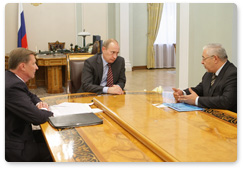
Vladimir Putin met with Deputy Prime Minister Sergei Ivanov and General Director of the Russian Electro-technical Institute Yury Kovalenko
Participants in the meeting discussed energy supplies.
Transcript of the beginning of the meeting:
Vladimir Putin: Mr Ivanov, you recently met with chief design engineers from our leading companies, mainly in the defence sector. I know you discussed energy efficiency with them.
What can you say about the results and the discussion? I would like to discuss this today in more detail. I will also meet with the same engineers. We will discuss a somewhat different topic, but we will certainly go back to this one, because energy efficiency is a major goal in the development of the innovation-based economy. We are pinning many hopes on it. Please, go ahead.
Sergei Ivanov: Mr Putin, on your instructions, last Monday I chaired a regular meeting of the Council of Chief and General Design Engineers on major trends in high-tech sectors of the economy at the Svetlana company in St Petersburg. At that time, we discussed the development and introduction of energy-saving technology in this country with all of the Council's members, including leading design engineers and engineers.
Putting it mildly, we are not good at saving energy. In GDP energy consumption we are 2.5 times behind the world's average, and even 3.5 times behind industrialised European countries, Japan, and the United States.
We are losing a lot of energy when heating housing. According to this indicator, we waste 3 times аs much electric energy and energy in general, even compared with our neighbours such as the Scandinavian countries and Finland, which are located in the same climatic zone.
During the discussion we reviewed a wide range of projects connected with the energy industry and transportation (such as railways and the metro), which consume a lot of energy in this country, and not always efficiently. The same applies to housing and utilities, which are also wasting energy, and, to state it plainly, money.
Allow me to introduce to you Yury Kovalenko, general director of the Russian Electro-Technical Institute, our leading scientific institution dealing with energy-saving technology. I would like you to give the floor to him so that he can give his expert opinion on specific projects.
Vladimir Putin: Please, go ahead, Mr Kovalenko.
Yury Kovalenko: Mr Putin, regrettably, in terms of energy consumptions per unit of GDP, the situation in this country leaves much to be desired. Most electric energy is lost not only and not so much in energy generation, because we have enough plans to improve generation capacity, although they have not been fully introduced. The bulk of energy is lost during its transmission and consumption, primarily in industry due to a lack of the adjustable frequency electric drives, but, naturally, in housing and lighting as well.
Speaking about these projects and the use of these resources, we have developed a number of technologies, primarily for transmitting electric energy, based on the experience of the world's best companies in maintaining transmission lines. Allow me to recall that the Soviet Union built the world's first 1150 kW high transmission line, and a ±750kW DC line. They are no longer in Russia now, but even now they are working to their full capacity.
Other countries, especially China, have made use of the best of these technologies. They have built multi-voltage lines using the best Soviet and Russian technologies. The master plan provides for their construction, but they have not yet been built.
But there have been projects in this area, and they were carried under the auspices of the priority federal targeted R&D programmes. Prototypes of the required equipment also exist - gas-insulated equipment, transformers, switching devices, converters, shunt reactors, and thyristors.
I will not go into much more detail on the technical side of this issue. I will only say that this technology will allow us to recover up to 15% of lost electricity.
More than half of energy is lost in the electric drives. There have been pilot projects of adjustable frequency electric drives, and new electric engines for resolving this problem, primarily in industry. But regrettably, our industry, which is mostly private, does not have a demand for them, and is not quite ready to produce them.
Vladimir Putin: Are you talking about equipment?
Yury Kovalenko: Take transmission lines, for example. Our institute has developed switching devices or gas-insulated equipment, which require much less metal. We have to work under contracts with China, which is producing this equipment. They place an order with us, we fill it, and they produce the equipment, for instance, the transformers.
Now let's discuss the use of energy at home, primarily in lighting. Оur technology is above the world level. I am referring to semiconductors above all. At the aforementioned Council meeting, we agreed that we should not necessarily follow the world in using new fluorescent lamps. We can skip this stage and use semiconductors in lighting fixtures, which will allow us to reduce the use of electricity for lighting by five to seven times.
Vladimir Putin: What are the costs?
Yury Kovalenko: The costs are pretty high, but I'd rather speak about the cost of the losses.
Vladimir Putin: I want to know how much these lighting units cost.
Yury Kovalenko: They are certainly more expensive now, since they are not mass-produced yet. I would like to focus on other figures, which will allow you to figure out the project's cost. Experts estimate that some 370 kWh, or 750 billion roubles, will be saved annually. This is a serious number. These are resources we can use.
Well, of course, this project needs investments, primarily from private companies, since they are the consumers. At the first stage, costs are likely to be twice as much as the funds saved. But these are one-time expenses, which will be offset within two or three years. Therefore, these projects' recoupment period is between two and three years.
Vladimir Putin: We need to encourage cooperation between the government and business, as well as develop an integrated plan to achieve this common goal.
Yury Kovalenko: Generating companies have shown willingness to participate. Nikolai Shvets from Interregional Distribution Grid Company visited our institute and showed interest in the diagnostic equipment we are developing, specifically the gas-insulated equipment that we have developed and manufacture in cooperation with Chinese companies. He expressed willingness to produce this equipment here, in Russia. He is eager to invest the required funds.
Vladimir Putin: Mr Ivanov, I would like you to prepare a draft of a directive to develop an integrated plan. It must not contain theses or slogans, but actual guidelines for the Government and business, as well as for government agencies. I'm referring to the Federal Grid Company, Russian generating capacity, and Russian utility companies - they all must operate in line with this integrated plan. Otherwise, it will remain pure rhetoric.
Sergei Ivanov: I have a suggestion. May I?
Vladimir Putin: Please do.
Sergei Ivanov: A protocol was approved after the Council meeting. I have already issued directives charging the Ministry of Energy, the Ministry of Industry and Trade, the Ministry of Education and Science and the Ministry of Economic Development with developing a road map for implementing specific energy efficiency projects, following the recommendations of the Council of Chief Designers.
Given that these projects must involve several agencies, rather than be assigned exclusively to a single agency, they must comply with world standards, and even exceed them technologically. They must be ready to be applied. So this must not be limited to pure research. These must be products, samples ready to be applied and bring profits.
One of the mandatory conditions is private companies' participation in funding these projects. At the meeting of the Council, we unanimously agreed that economic measures are needed.
We decided to call them "economic carrots and sticks". The "carrots" would be preferential tariffs for the companies that phase in energy-efficient technologies at their production facilities, as well as in housing and utilities. Accordingly, the "sticks" would be for those companies that haven't introduced the products available in the market. These companies will simply pay a higher price for using energy-consuming technologies.
Vladimir Putin: All right. So as a result the agreements reached at the meeting of the Council of Chief Designers, you must prepare a draft of a directive to develop an integrated plan to ensure energy efficiency, one that would involve the state as well as private companies.
Sergei Ivanov: I've got one more idea.
Vladimir Putin: Go ahead, please.
Sergei Ivanov: I was surprised to learn about another effective method of saving energy. Last week the Minister of the Interior, Rashid Nurgaliyev, and I visited the Internal Affairs Directorate of Moscow's North-Eastern District. It is the third Internal Affairs Directorate in Moscow to...
Vladimir Putin: ...to install GLONASS?
Sergei Ivanov: Precisely. All police vehicles, including those of the patrol and inspection service, traffic police and non-departmental security forces, are fitted with GLONASS equipment. Naturally, this helped these departments to increase the percentage of criminals caught. In addition, the heads of the District and Central Internal Affairs directorates are now able to monitor their employees' activity better; they can see where these vehicles are and what they are doing. Police chiefs report diminished fuel costs for these vehicles.
Vladimir Putin: So they now go visit the girls in buses, not in administrative cars.
Sergei Ivanov: Exactly. And they don't go to markets any longer. They serve where they are supposed to be serving.
Vladimir Putin: The introduction of GLONASS must be continued, as we have agreed. The Russian-produced GLONASS system must be applied to all government means of transport, including by air, railway, car and sea.
How many satellites will be in orbit by the end of this year?
Sergei Ivanov: 24.
Vladimir Putin: Have there been any delays?
Sergei Ivanov: Practically none. The GLONASS signal can be picked up in Russia and the CIS countries.
Vladimir Putin: But there is a delay as far as the grouping formation deadline is concerned. I would like you get this issue under control to ensure that everything will have been completed by the end of this year.
Sergei Ivanov: All right.
