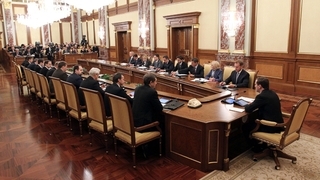
Government meeting
Transcript:
Dmitry Medvedev: Ladies and gentlemen, today we have an extensive agenda, as usual. I’ll start with a report on the results of our efforts to establish crisis control centres. This is an important subject. It concerns our ability to protect our people and territories in the event of natural or man-made disasters. The events that took place in the Krasnodar Territory this summer demonstrated how much depends on having a timely early warning system and organising work with the people under such circumstances.
I’ve just been to the national crisis control centre. The formation of the integrated daily control system will be useful. It operates at the federal, interregional and regional levels. Apart from the national centre in Moscow, there are eight centres in Moscow's administrative areas, and 80 situation centres in the regions. They continuously receive real time information and I hope that this information is fully authentic and objective. These control centres extinguish up to 400 fires every day and neutralise several dozen emergencies. I emphasise that they do this every day. Regrettably, the most varied emergencies take place in this large country. Thus, several days ago there was a fire in the Saratov Youth Theatre. This is, of course, a sad event, but what matters most is that during the performance 450 spectators, including children and people with disabilities were quickly evacuated, from the theatre. None of the spectators were hurt, although the fire was very dangerous and threatened to spread to nearby districts. However, tragic consequences were avoided thanks to the professional work of fire fighters. This is an example of how to work in such situations. We must continue working on speeding up the response of control centres, using the latest communication equipment. People should know about how they may receive a signal, how they will be warned about impending danger and must be able to act in emergencies without panic.
Forecasting is vital for warning about emergencies. We will introduce space monitoring and modern network technology. It goes without saying that technical equipment is important, but it is not a cure-all. It is very important to employ professionals, high class specialists that are ready to be responsible for their work. But the general readiness of people to counter emergencies is also crucial. This is the goal of the civil defence system, which is marking its 80th anniversary today.
Another item on our agenda is migration legislation, an extremely resonant issue.
I’d like to say right away that the relevant proposal suggests toughening criminal responsibility for the violation of migration legislation, and introducing corresponding amendments to the Criminal Code of the Russian Federation. The issue is that the number of cases is growing. In 2006, for example, 230 criminal cases were launched at the initiative of the Federal Migration Service, as compared to about 400 last year. That said, all those who were taken to court had to pay a relatively small sum of five thousand roubles and were set free. Therefore, it is essential to both increase fines and toughen real punishment for offences. The fines should be raised to the top level of 300,000 roubles, and the longest prison sentence to a term of up to five years. If an offence was committed by an organised group, the punishment should be tougher – up to seven years in prison.
We continue implementing measures to meet our obligations under the Convention on the Rights of the Child. Today, two draft federal laws have been submitted to this effect. They concern amendments to specific laws and to certain provisions of the Criminal Code and the Criminal Procedure Code. They are all aimed at protecting children when their rights are violated or they find themselves in a difficult situation.
I’d also like to say a few words on another important subject. It concerns support of our agro-industrial complex in the context of Russia’s WTO entry, specifically government support for agricultural producers who are working in unfavourable conditions. This is a normal thing to do. Such support fully conforms to our WTO agreement, and does not fall under any mandatory restrictions. Amendments to the law on the development of agriculture have been drafted. They suggest identifying as unfavourable the conditions of those regions where the profit level of agricultural production is lower than the national average due to the social environment, nature and climate, or other factors. We, the Government of the Russian Federation, will decide the order and criteria by which certain territories will be qualified as regions with unfavourable conditions. I hope that this mechanism will allow us to better protect the interests of our agricultural producers.
In addition, I’d like to tell you that I’ve made a decision on the start of grain interventions with a view to regulating the general balance on the grain market. I’m instructing the Minister of Agriculture to prepare proposals on the scale of interventions, on the regions where they should be made and on all other important issues. Mr Dvorkovich, please report on the final proposals to me as soon as possible.
The first item is on setting up crisis control centres. Mr Puchkov, please go ahead on this subject, which we’ve just discussed in our crisis centre of the Emergencies Ministry.
More to be posted soon...
* * *
Following the Government meeting, Deputy Prime Minister Olga Golodets commented on the decision to establish the Government Council on Guardianship
Olga Golodets: Good afternoon, colleagues. I will brief you on the recent establishment of the Government Council on Guardianship.
It is impossible to implement social policy projects today without the active participation of civil society. Guardians who are now working in most of the social services institutions addressed us with a request in July to establish such a council so that the Government has an efficient instrument for cooperation with activists and volunteers who work in social care establishments.
The Government Council on Guardianship will engage only in social care establishments – hospitals, hospices, educational institutions and orphanages. This is a very special kind of guardianship because it concerns the most vulnerable social categories – disabled people, orphans, children in difficult circumstances who are confined to hospital beds for a long time. That’s why the role of this council is hard to overestimate because these vulnerable social groups need permanent care from the state and society. I am glad that committed people whose work has already proved that they are capable of developing and improving the system have joined the council – Chulpan Khamatova, Yegor Beroyev, Yulia Basova and many other wonderful people. I hope that the formation of this council will change the level of cooperation between government agencies and civil society institutions.
